
Last updated November 18, 2026
When a credit bureau verifies incorrect information after a dispute, the Fair Credit Reporting Act asks whether anyone actually reinvestigated. The bureau must conduct a reasonable reinvestigation within 30 days, review and consider everything the consumer sent, and delete what is inaccurate or cannot be verified. 15 U.S.C. § 1681i(a)(1)(A), (a)(4), (a)(5)(A). The lender that reported the account has its own duty to investigate once the bureau tells it about the dispute. § 1681s-2(b). This post is by Darren Newhart, a consumer protection attorney with Newhart Legal, P.A. in Loxahatchee, Florida.
Many consumers take a failed dispute to the government next. About 90 percent of consumers who complained to the Consumer Financial Protection Bureau about Equifax, Experian, or TransUnion since 2020 said they had already disputed with the bureau. That figure comes from a CFPB report published in December 2025.
The verification usually comes from the lender. In 2011, the CFPB found, the three national bureaus sent about 85 percent of disputes to the lenders that reported the accounts, through an electronic system called e-OSCAR. Each dispute traveled as one or two reason codes, chosen from a list of 29, and up to 255 characters of the consumer's own words. Since 2013, the CFPB says, e-OSCAR can also carry the documents a consumer mails in.
Here is a composite. A Riviera Beach teacher settles a credit card debt in 2025 and keeps the bank's letter saying she owes nothing. In 2026 her Experian report still shows a $4,300 balance, past due. She disputes with Experian and attaches the letter. Twenty-two days later Experian writes that the account was "verified as accurate."
What does the credit bureau have to do with my dispute?
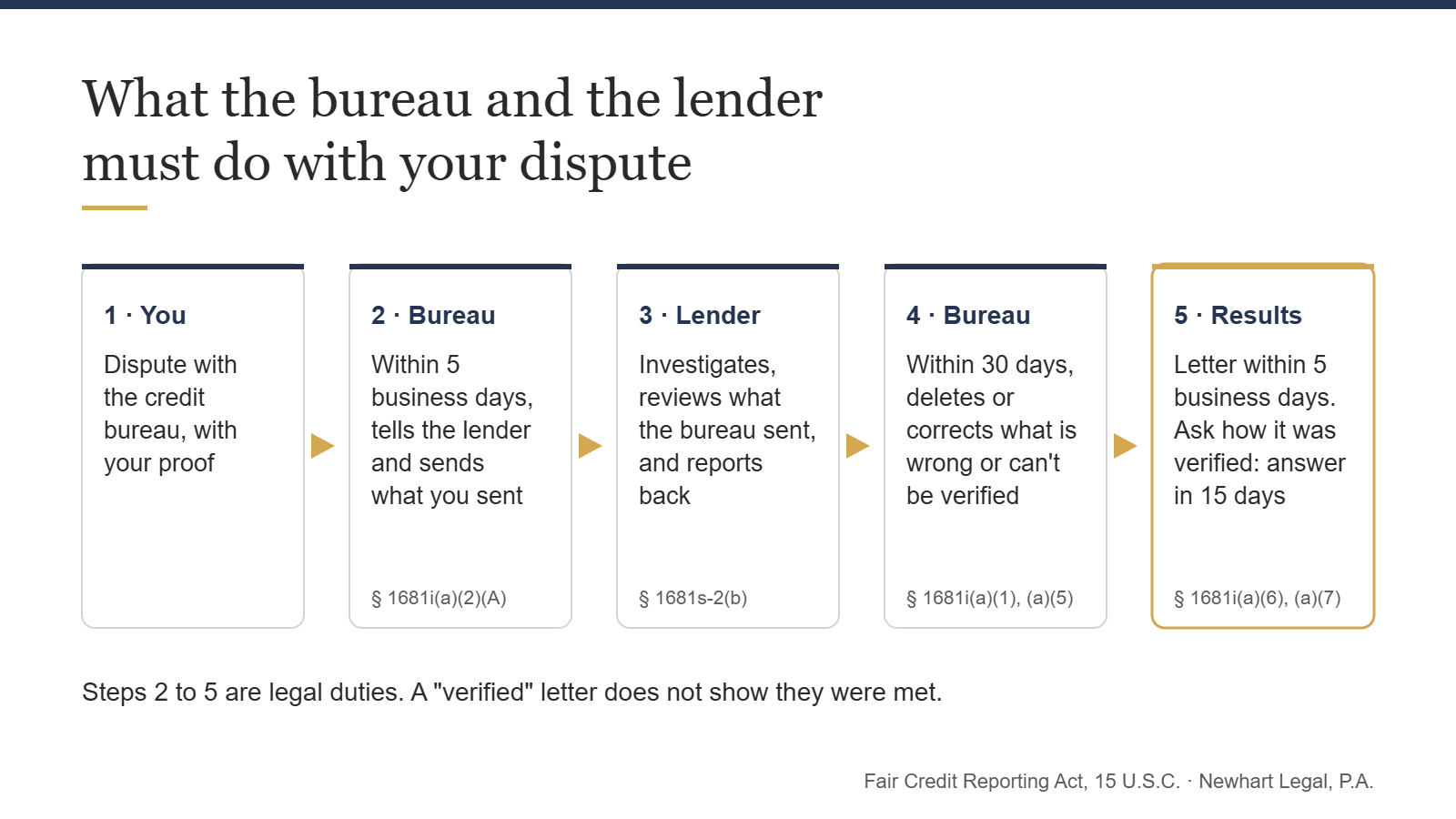
Reinvestigate it, and not on autopilot. Within 5 business days of receiving the dispute, the bureau must notify the company that reported the account, the furnisher, and pass along all relevant information the consumer sent. 15 U.S.C. § 1681i(a)(2)(A). If the item turns out to be inaccurate, incomplete, or unverifiable, the bureau must delete or correct it and tell the furnisher. § 1681i(a)(5)(A).
A settlement letter saying the balance is zero is the kind of information the statute tells the bureau to consider. § 1681i(a)(4). A separate page covers when a consumer can sue a credit bureau, and another covers the dispute itself: does disputing hurt your credit.
What does the lender have to do?
Investigate too. Once the bureau notifies it, the furnisher must conduct an investigation, review all relevant information the bureau sent, and report the results. If the information is inaccurate or incomplete, it must report that to every national bureau it reported to, and modify, delete, or block the item. 15 U.S.C. § 1681s-2(b)(1). It must finish within the same 30 days the bureau has. § 1681s-2(b)(2).
That duty is enforceable in court. The FCRA bars private suits over a furnisher's general accuracy duties in § 1681s-2(a), but not over its duties after a bureau dispute. § 1681s-2(c). A dispute sent only to the lender, and not through a bureau, does not trigger § 1681s-2(b).
How do I find out how the bureau verified it?
Ask. The bureau must send the results in writing within 5 business days after the reinvestigation ends. 15 U.S.C. § 1681i(a)(6)(A). On request, it must describe the procedure it used, including the business name and address of any furnisher it contacted, within 15 days. § 1681i(a)(6)(B)(iii), (a)(7). This is often called a method of verification request.
Two other rights follow a verified dispute. The consumer may file a brief statement of the dispute, and the bureau must note the dispute in later reports, with the statement or a summary of it. § 1681i(b), (c). And on request, the bureau must send a deletion notice or that statement to anyone who received the report in the prior six months, or two years for employment. § 1681i(d).
Experian's dispute address and what Experian owes a consumer are on the page about suing Experian.
When does a verified dispute become a lawsuit?
When the reinvestigation was not reasonable and the error cost the consumer something. A negligent violation carries actual damages and attorney's fees. 15 U.S.C. § 1681o(a). A willful one carries actual damages or statutory damages of $100 to $1,000, plus punitive damages the court allows, costs, and fees. § 1681n(a). The claim must be filed within 2 years after discovering the violation and no more than 5 years after it occurred. § 1681p.
The proof is usually on paper. The dispute and what it enclosed. Proof of when the bureau received it. The results letter. The lender's settlement letter. And the denial or rate notice that followed.
In the teacher's case, a bureau and a bank both had the zero-balance letter, or should have, and the account stayed.
I am Darren Newhart, a consumer protection attorney in Loxahatchee, Florida, admitted to the Florida Bar in 2015 and to the Southern and Middle Districts of Florida and the Eleventh Circuit. Newhart Legal, P.A. brings credit reporting cases for consumers in Palm Beach County and across South Florida. If a bureau verified something you proved was wrong, call or email me.
Questions people ask
What does "verified" mean on a credit dispute?
It means the bureau's reinvestigation ended with the item unchanged, often after the lender that reported it confirmed its own records. The FCRA requires a reasonable reinvestigation that considers what the consumer sent. 15 U.S.C. § 1681i(a)(1)(A), (a)(4).
How long does a credit bureau have to answer a dispute?
Thirty days from receiving it, extendable by up to 15 days if the consumer sends relevant information during that period, or 45 days for a dispute made after a free annual report. The results notice is due within 5 business days after the reinvestigation ends. 15 U.S.C. §§ 1681i(a)(1), (a)(6)(A), 1681j(a)(3).
Can I sue the lender that verified the wrong information?
Yes, for failing its duties after a credit bureau notifies it of the dispute. 15 U.S.C. § 1681s-2(b). The FCRA does not allow private suits over a furnisher's general accuracy duties, and a dispute sent only to the lender does not trigger § 1681s-2(b). § 1681s-2(c).